Pendle RWA Insights — A Case Study on Asseto NGI+
A joint Pendle and Asseto look at how NGI+ brings Partners Group’s infrastructure fund onchain, and what holders can do with it once Pendle splits its yield.

This article was written jointly by Pendle and Asseto.
Tokenization has made it possible to bring everything from money market funds and credit products to private market strategies onto public blockchains. But simply putting a fund onchain doesn't necessarily change what investors can do with it. The more interesting question now is what investors can do with it once it is there.
NGI+, Asseto's tokenized exposure to Partners Group's Next Generation Infrastructure strategy, offers a glimpse of that next step. It brings a traditionally private-market investment onchain while preserving the fund's existing legal and regulatory framework and through Pendle, investors gain access to a market for its future yield, opening up new ways to engage with an asset that was previously much harder to use in DeFi.
Why NGI+?
NGI brings a different source of investment returns into DeFi. Its underlying strategy invests in infrastructure businesses across areas such as power, energy, digital infrastructure and essential services. Performance depends on how those businesses operate, grow and are ultimately valued, rather than solely on crypto borrowing demand or token incentives.
The strategy combines direct investments in infrastructure companies and assets, where Partners Group may take an active ownership role and support operational improvements and business development, with private-market secondary investments, where the fund acquires existing interests in infrastructure funds or through GP-led transactions. For onchain investors, this provides diversified exposure across both direct infrastructure investments and established private-market portfolios that would be difficult to replicate independently.
From Fund to Token
Traditional investment funds and blockchains operate very differently. A fund follows a set dealing calendar, maintains an official register of ownership, and has rules governing who can invest and when they can redeem. Blockchains, on the other hand, operate around the clock, allowing tokens to move between wallets and interact with applications at any time.
The core task is bringing the two together without breaking the rules of either, and NGI+ does this by separating legal ownership of the fund units from the onchain transferability of the exposure they carry.
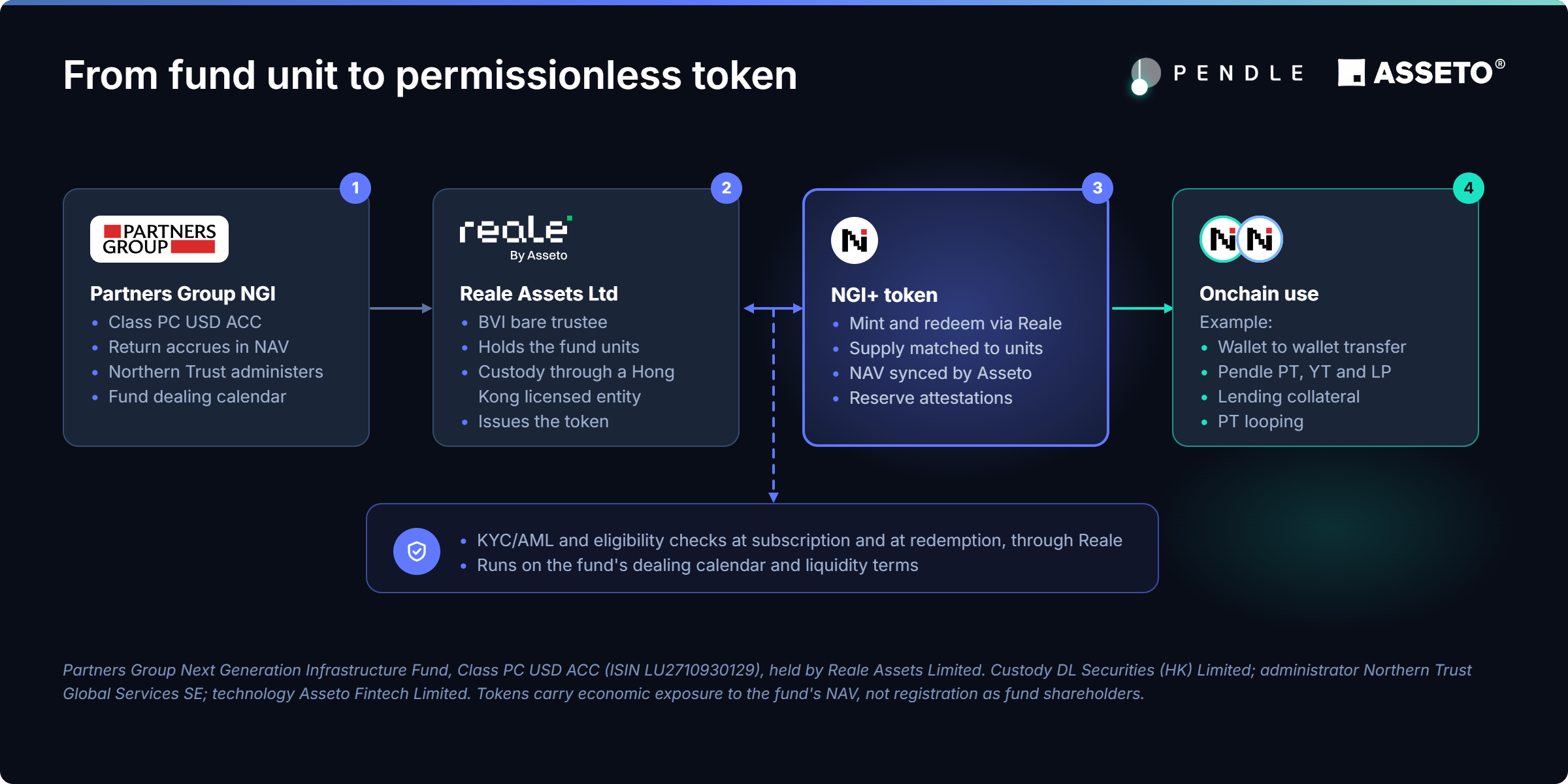
Reale Assets Limited, acting as a bare trustee, holds units in the accumulating USD class of Partners Group's fund through a Hong Kong SFC-licensed custodian. Asseto provides the infrastructure to tokenize and administer that exposure, without taking on any discretionary role in managing the investments themselves.
When an NGI+ token changes hands, the fund units themselves don't move. They stay with Reale, while the token carries the economic exposure to the fund's NAV to a new wallet. Tokenholders therefore share in the fund's performance through the token and trust arrangements, without becoming registered shareholders of the fund.
To keep the two sides aligned, Asseto connects the fund's NAV information and custody records with the tokens circulating onchain, supported by reserve attestations and ongoing reconciliation. This onchain transferability means NGI+ can move between wallets and interact with compatible DeFi protocols without requiring the underlying fund to process a transfer every time.
Asseto's role continues after issuance. Subscriptions, redemptions, NAV updates and token supply need to remain consistent across two different operating environments. Coordinating these processes, together with the requirements of compatible protocols, is what turns the fund exposure into a usable onchain product. It is also the capability Asseto aims to extend to more institutional investment strategies.
Compliance Structure
Bringing institutional assets onchain also means squaring securities regulation with networks that anyone can use. NGI+ handles this by keeping compliance checks at the points of entry and exit, and letting the token move freely in between.
When subscribing, investors complete KYC/AML and eligibility checks through Reale, and tokens are only minted once a subscription has been accepted, allocated and backed by fund units. The same checks apply at redemption, which stays subject to the fund's dealing calendar and liquidity provisions. Simply holding NGI+ doesn't give an unidentified wallet access to the redemption process.
Between those two points, NGI+ can be transferred without issuer approval or fresh KYC for each transaction, which is what lets it work with protocols such as Pendle. That freedom doesn't override securities law, sanctions or eligibility requirements, and secondary venues and protocols remain responsible for their own obligations, which vary by jurisdiction and activity.
Blueprint for Tokenized Funds
Asseto designed the Reale framework to be reusable, with the same structure already supporting PGNGI+, BOND+, mYIELD+ and EPOCH+. While each product still requires its own legal, custody, valuation and redemption arrangements, much of the underlying infrastructure can be shared. Asseto also supports tokenized money market funds such as CASH+, GTCASH+ and CNCASH+ through separate structures. As of September 30, 2026, its portfolio spanned more than 25 products and projects, with approximately $467 million in total value locked.
The opportunity to scale is significant. It gives onchain access to a fund from Partners Group, a top-tier global private market investment manager with $186 billion in AUM.
After the product is tokenized, the natural next step is to scale its onchain liquidity by giving it uses native to DeFi. A position in an evergreen infrastructure strategy with a market-implied fixed yield, or a fund-linked token that can be borrowed against on a supported market, may appeal to investors who might never have subscribed to the fund directly. This is where integrations like Pendle become important. Any demand onchain directly translates into growth for the underlying fund, since each new NGI+ token is minted against new units in it, and there’s no fixed cap on how many NGI+ tokens can be issued.
Longer term, this would become a model other asset managers can use to bring a strategy onchain, keep the rights and reporting investors expect and connect it to trading and financing markets, with the structure adapted to each asset rather than rebuilt from scratch.
The opportunity also runs in both directions. Onchain investors gain access to professionally managed strategies they would find difficult to assemble themselves, while traditional investors can explore DeFi through assets and investment concepts they already understand. Asseto's aim is to make that connection repeatable, with NGI+ providing an initial case rather than the endpoint.
Scaling with Pendle
Pendle is a non-custodial yield-trading protocol that separates a yield-bearing asset into its principal and its return, in the same way a Treasury bond can be stripped into principal and coupon pieces. The principal token (PT) behaves like a zero-coupon bond, bought below par and redeemed at par on a fixed maturity date, so its return is known at purchase. The yield token (YT) behaves like an interest-only strip, collecting the asset's return until maturity and then expiring worthless. Both trade against liquidity pools and an order book.

For NGI+, this brings in investors the fund would not otherwise reach. PT buyers can lock in an outsized fixed rate to maturity - a rate has traded above the fund's own return because the Pendle market also prices in Asseto Points, which are associated with potential future token distributions.
YT buyers get leveraged exposure to the combined yield without committing the full principal, and liquidity providers earn trading fees and incentives for supporting the market.
Pendle's tokens can also be used across other DeFi protocols, most commonly as collateral for borrowing. Aave and Morpho, the two largest onchain money markets for instance, already accept a range of Pendle PTs as collateral, with more than $400 million deposited as of October 26, 2026.
Through PendleLoop, holders of supported PTs can borrow stablecoins against their positions and buy more PT in a single transaction, much like a repo-financed carry trade. This lets investors scale up their fixed-yield exposure, though the leveraged return still depends on borrowing costs and carries liquidation risk. On some of the most active stablecoin PT markets, looped yields reached the high 40s percent in mid-October.

Looping allows PT fixed yield to be levered, enhancing yield up to as high as ~50% APY
That extra utility tends to show up as demand for the underlying asset. Dune Analytics coined the term "The Pendle Effect" after finding that stablecoins gained holders and supply once Pendle listed them, and a similar effect has since been seen in tokenized RWAs. STRC, Strategy's variable-rate preferred stock, is one example where Pendle held nearly $500 million in STRC-linked assets at its peak, the large majority of its onchain supply.
For tokenization platform such as Asseto and the asset managers they work with, greater demand can support new NGI+ issuance, with each newly issued token backed by exposure acquired through the underlying fund. As more maturities are introduced, Pendle could also establish a market-implied yield curve for NGI+, bringing a new layer of price discovery to an asset class that has traditionally lacked one.
Beyond Tokenization
In our view, the next chapter of tokenization won't be defined simply by how many assets make it onchain, but by what investors can actually do with them once they get there.
Most of the pieces for that already exist in DeFi. Pendle’s yield markets let investors price and fix their returns, lending markets such as Aave and Morpho let them borrow against what they hold, and decentralized exchanges give continuous price discovery around the clock. Since each of these is permissionless, a new protocol can plug into a tokenized fund without a bilateral agreement or a new custody arrangement, which lets a fund reach investors and scale in ways that are hard to replicate in traditional markets.
NGI+ is an early example of what that looks like, or as Asseto puts it, "an important reference case, not proof that the work is finished." Scaling the model will take deeper liquidity, clear reporting and operating arrangements institutions can rely on. Asseto plans to build on it with Pendle and other partners, bringing more professionally managed strategies into DeFi and giving traditional investors a way in through assets they already know.
The significance of this first integration is the opportunity to develop that relationship further. Partners Group manages the underlying infrastructure strategy, Asseto connects the investment exposure with an onchain operating framework, and Pendle provides a market for principal and future yield. Deeper cooperation around those roles could make more institutional strategies accessible and useful within DeFi, while giving asset managers a clearer route to a new investor base.
Estimates for the tokenized asset market by 2030 range from roughly $2 trillion in McKinsey's base case to more than $10 trillion. The projections are promising but ultimately, the funds behind it will only be as useful as the markets built around them. Asseto's Reale framework gives asset managers a repeatable way to bring a strategy onchain with its compliance and reporting intact, so the next fund does not need its own structure built from scratch. Pendle gives that fund a market once it arrives, the onchain equivalent of the $500 trillion interest rate swap market, where its yield can be fixed, traded and financed.
The plan is to have these plumbing networks well established so that when tokenized funds arrive at scale they can already hit the ground running.